The Price is Right? Robb Corrigan of Blue Water Index shines the light on boat pricing.

Imagine being so frustrated by the boat buying process that you start a company and travel the world to bring transparency to the boat market.
When Robb Corrigan first started searching for his dream boat, he was stunned by the opaqueness of boat pricing. He went down a research rabbit hole so deep that it led to the formation of his new startup, Blue Water Index. After a soft launch this summer and the announcement of a $2 million funding round, the Ontario-based sailor and former IBM pro brought his message to Europe’s biggest boat shows, including Cannes. Now he’s planning to shake up the American boating industry and shed light on a business that has often preferred to keep consumers in the dark.
“I didn't plan to start a company, I was actually trying to buy a boat,” said Corrigan, who started working in software 30 years ago for a company that was later bought by IBM. “I spent my entire career in tech unrelated to my sailing passion. So, you know, the ability to combine the two is just a dream for me, right?”
Boat sales and surveys have long relied on the practice of comparing similar boats to come up with a best guess at a fair price. The perennial problem for buyers is that boat pricing still often feels like a black box, and two seemingly similar boats can have wildly different asking prices. What Blue Water Index sets out to do is come up with an international standard price, working with brokers, manufacturers, buyers, and by using proprietary artificial intelligence to pull from worldwide boat listings and specs sheets.
“It's hard to price a boat,” said Corrigan. To illustrate just how wildly different similar boats can be priced, he added a mobile app game called Valuation Challenge to the Blue Water Index website. “We're going to really be hitting the brokers that can to see how they perform. I can't wait to sit in front of a broker and see how well he does.”
Engineering Mindset
What’s especially telling about Blue Water Index is that it seems to separate marketing hype from good engineering. For example, while one industry pricing guide used by hundreds of dealers brags on its website that it is, quote, “the bible” for boat valuations, resting on its legacy reputation, Blue Water Index is busy hiring a data scientist (who is also a veteran from IBM and Microsoft). The Index also prominently asks for corrections, details data policy and methodology, and even has bot ethics for its web crawler, stating that, “BlueWaterIndexBot identifies itself on every request, carries a contact address in its user-agent string, and has a page of its own for whoever finds it in a log file. It never pretends to be a browser.”
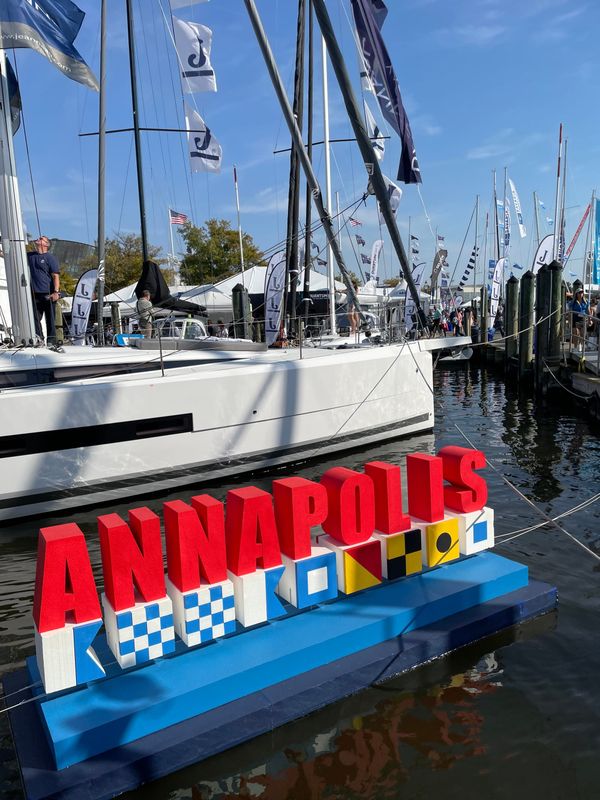
That “engineering mindset” also shows in how Blue Water Index approaches its own launch. Rather than jumping right into the American market and showcase at places like FLIBS and the Annapolis boat shows, Robb is starting in Europe, because, he says, European data standards are higher than in the US. Adding that real-time “stress test” may yet help vet and build a better product, and that all feels contrarian when startup culture pushes the mantra of “fake it ‘til you make it.” Corrigan says he plans to introduce Blue Water Index at US boat shows through 2027, although it is available now at no cost to American boaters.
“So we're doing Cannes, Southampton in England. Genoa in Italy, and Metstrade in the Netherlands through the fall season. We may do Dusseldorf in January, in… I think it's January or February in Germany, and then there's Palma in the spring in Spain as well,” said Corrigan. “We've been to Cannes and Southampton, made some encouraging progress validating our valuation model, and are now exploring several interesting partnerships with marketplaces, brokers and marine finance companies. In many ways, the business is evolving beyond simply valuing boats into something much broader around independent marine-market intelligence.”

Fixing what’s “broke” with brokering?
Blue Water Index seems to take a “no BS” approach with its service, offering users a free and instant report with no sign up or credit card required (an email address is required to view the report, but once an email is given, the report is displayed instantly, and one may de-select from being contacted). The report is thorough and offers a range for pricing, comparables, and even suggested questions to ask the broker.
This is certainly a powerful tool for the everyday consumer, who is now instantly armed with the kind of information that was once closely held by industry insiders. It’s long been understood by economists that a problem with many markets is “information asymmetry," where one party in the transaction (usually the buyer) has less information about the product being sold than the other party (usually the seller). Entire industries prosper by keeping the buyer in the dark. The internet, of course, did much to level the playing field, but the boat market is unique enough where two seemingly similar boats can still have wildly different prices.
Buyers looking for a new boat already have limited options thanks to state “franchise laws,” which effectively give local monopolies to dealers of select brands, due to heavy lobbying by boat and car dealers. If the new boat market can feel highly controlled, then the used boat market can feel like a free-for-all, because there is a much lower barrier to entry for dealers who deal in multiple brands, while private listings and classifieds are mostly unregulated.
On top of these market realities, boat buyers can sometimes be left in the dark about significant incidents in a boat’s past that could affect its price, or even impact the structural integrity of the boat. Sometimes even a seasoned surveyor can miss major concerns and flaws with a boat. (For an in-depth case study on one of the worst examples of such an information disparity, see the mini-documentary about the Cheeki Rafiki by James Evenson on his channel “Be The Captain” on YouTube).
Comparing the Comparisons
Blue Water Index does stand out as unique in what might otherwise be a crowded market. Kelley Blue Book doesn’t even bother with the boat market, posting an entire article that repeats emphatically that, “There are no Kelley Blue Book® Values for boats.” And why not? Because, they state, “Good data is too hard to come by.” One AI-based model premiering in Annapolis in October aims in the direction of Blue Water Index with a "pre-survey survey" reviewed by a professional, but at $295, it's priced close to the cost of a full survey. The industry’s legacy reference books include The BUC Book and ABOS Marine Blue Book. BUC rides on its reputation and still calls itself the “‘Bible’ for the boating industry.” BUC sells a large tome that looks like a phone book while ABOS (Price Digests) offers subscriptions starting at $334 annually – both are priced high for many consumers and are instead marketed to industry insiders like dealers and manufacturers. JD Power rebranded the old NADA Boat Guide, and while this does get kudos for offering a free tool for buyers, the site feels inundated by the Google Ads and popups offering boat valuation services that may have confused more than one shopper.
An Emotional Decision
“Buying and selling a boat is an emotional decision,” Corrigan added. “It's your discretionary funds, of course, so there's a lot of passion in that, and when there's a lot of passion in it.”
Corrigan may end up becoming the world’s leading expert on boat prices, because he’s in the unique position to be immersed in more data about boats on any given day than many boaters will consume in a lifetime. He’s sharing his insights at no cost to boaters, and with better tools and market intelligence, boat buyers can better separate emotion from the dollars and cents of boat buying.
So, did Robb Corrigan ever buy his dream boat that started him on this startup journey?
“This particular boat that I was looking for was going to get me across an ocean. So I have a bucket list to sail across the ocean alone,” he said. “I was planning to go in 2027, but I took the money that I was going to use to buy the boat and started a company, so it's delayed. It's not delayed for a long time. Probably get back to it within the next 5 years.”
Learn more about Blue Water Index and try their boat buyer feature on their website:
Like stories like this? You know what to do. Subscribe to Sailicon Valley.
[Learn how to sponsor a post on Sailicon Valley].
(C) All Rights Reserved.