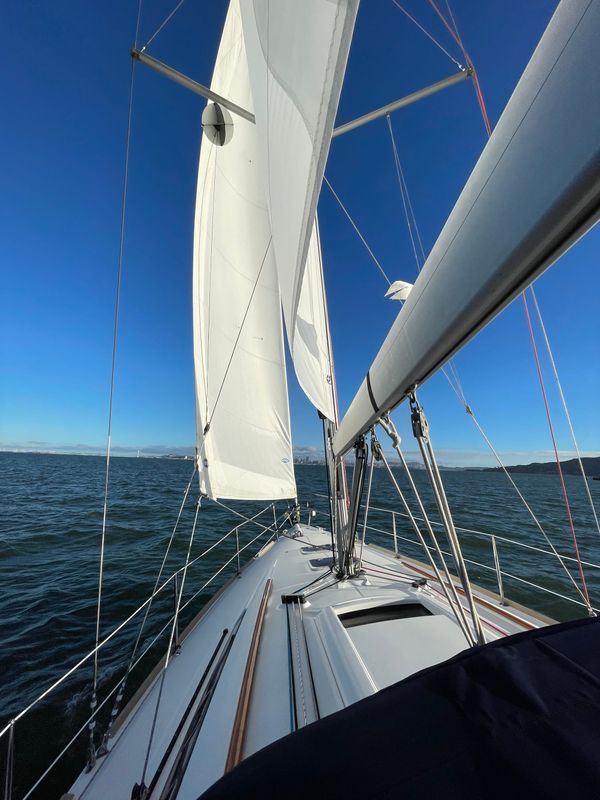
Meet the people who work remotely from their boat

You’re on a Zoom call and the guy on the other line has a background of a tropical island scene, replete with palm trees and azure waves lapping against a beach. Obviously just a digital backdrop, right? But imagine if you really could work remotely from your boat while cruising the world. In this piece, we'll discuss some of the ways people are doing exactly that, living the dream, and you’ll learn the technical ins and outs of turning this fantasy into a reality.
Comms check
First, let’s talk comms. Communications are more readily available, accessible, and cheaper than ever before.
In the 1987 movie Wall Street, when Michael Douglas made a work call from a beach in the Hamptons using his brick-sized cell phone, at the time such a call was a rare flex and status signal. But that scene foreshadowed today’s nearly universal access to remote work, when anyone can make that call from a beach (or a boat), for less money, with better signal, and with a much smaller phone (with video!).
At the marina, you can usually rely on the tried and true favorites you’re used to like WiFi and a cell signal. Cell phones lose signal only a few miles offshore, so even if you’re only planning a little cruise up and down the coast, you’ll need to step up your comms game. For coastal cruises up and down the shore, consider a marine signal booster. Similar to that WiFi booster that boosts the signal in your garage, these devices boost cell phone signals from land to your boat, allowing for cell and data access up to 30 miles offshore.
But in the middle of the ocean, there are no cell towers, so you’re going to want a satellite phone. Sat phone options include Iridium, Inmarsat, Thuraya are just a few popular options. Even the big cruise ships use satellites for their guests’ WiFi on board. Starlink changed the game dramatically, bringing internet access to even the most remote ocean-bound workers, from Pitcairn to Point Nemo. But do your homework, because satphones are illegal or restricted in certain countries (such as India, Sri Lanka, China, Russia).
Cash or card?
Online banking is accessible from your boat using the same sat comm features mentioned above. Credit cards are practically universal, so unless you’re planning to travel to North Korea or another country under similar sanctions, you should be able to count on your plastic to work abroad. In a few situations, cash is still king, and you’ll want to consider how to safely access and spend cash abroad.
You’re got mail
If you’re trying to keep your jaunt a secret from snooping co-workers, or if you just need packages and snail mail forwarded to your boat, then consider a mail forwarding service. A few options include Dockside Mail, Anytime Mailbox (previously Traveling Mailbox), and Earth Class Mail (owned by LegalZoom).
Part-time counts, too
Working remotely from a boat can be a “spectrum,” and isn’t limited only to the fulltime sailors living and working on a boat. Part-time work counts too. This is an important distinction for those who want to indulge the fantasy but can’t afford the full jump into sailing life. Nudging one Zoom meeting or a few hours a week to working on a boat can make a big difference in inching one step closer to the dream.
To tell or not to tell?
Let’s face it, people can be jealous, especially co-workers. And what some people consider sharing others call bragging. So maybe think twice before sharing with everyone on the team call that you just spotted dolphins as you island hop along the BVI.
Like stories like this? You know what to do. Subscribe to Sailicon Valley.
[Learn how to sponsor a post on Sailicon Valley].
(C) All Rights Reserved.