Quantum knots from Beyond
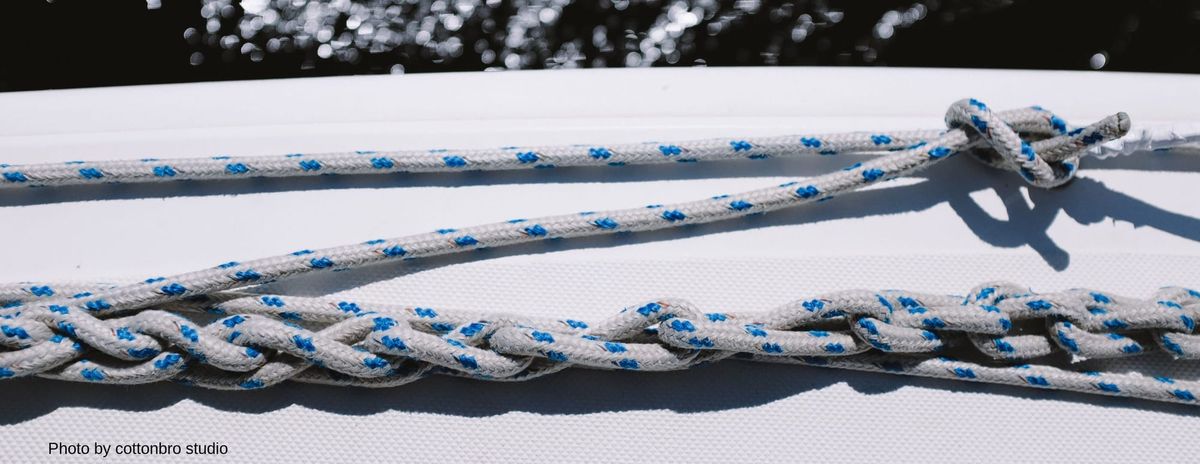
Think you got a tough knot? Here are knots so complicated that they only exist in another dimension.
The whole point of nautical knots is that they need to be strong and reliable while remaining simple to tie and untie quickly and with ease. But every sailor still deals with the occasional cantankerous knot, those stubborn suckers that seem so stiff and stuck that you need to pull out your marlin spike just to loosen them.
So imagine encountering a knot so knotted up, so tangled and tough that it required the help of a mathematician or even a quantum physicist. Welcome to the world of topology, the science of knot theory, where some knots are so complex that they exist outside the bounds of reality.
Curiously, all knots are undone instantly when a fourth dimension is added, reducing the most ostentatious knot into a humble circle. That means, in our day-to-day reality within the limits of three spatial dimensions (length, width, height), any knot you’ve ever tied, whether it be a bowline or a monkey’s paw, ceases to be a knot in four-dimensional space (4D). Even the Conway knot with its 11-crossings, a knot that took 50 years to “untie,” is no match for 4D. (For a fun explainer with Carl Sagan about how we perceive dimensions, watch his 1980 video, “Flatland.”).
Simple spheres become knots in a higher dimension – meaning that mooring ball you can’t hook to save your life actually causes multidimensional grief. And there are attempts to take this all a step further, to create nearly unfathomable, higher dimensional knots. Examples of these strange creatures include “magnetic knots” or hopfions, and “wild knots,” which become progressively smaller to infinity, making them nearly impossible to fully untangle.
More than just abstractions, complicated knots may shine new light in distant fields of study, and may even have practical, real world applications. Knots are relevant to mathematics, quantum mechanics, quantum data storage, and maybe even future medicine and understanding the shapes of DNA strands, because, as one scientist put it, “the physical properties of knots are important in understanding the stability of macromolecular structures.” And quantum knots are even used to explain the birth of the cosmos, when researchers claimed that in the time immediately after the Big Bang, “twisted knots of energy… collapsed to create all the matter around us,” in a period called the “knot-dominated era.”
Think about that next time you’re tangled up with a tough knot, then maybe that knot won’t seem so complicated. And be happy that you’re not in a knot-dominated era.
A sailor really only needs to know a few knots to handle most situations that arise on a boat, everything beyond that is just showing off. But that’s why we’re here, to help you show off. So here are four knots to master if you want to peacock and impress your friends at the dock (check out Animated Knots for step-by-step instructions):
- Monkey’s Fist (used as a weighted heaving line),
- Turk's Head (an intricate tubular covering knot),
- Diamond Knot (used for decorative lanyards). And last but not least:
- The Dragon Bowline. (Ya know, draggin’).
Like stories like this? You know what to do. Subscribe to Sailicon Valley.
[Learn how to sponsor a post on Sailicon Valley].
(C) All Rights Reserved.